Wednesday, March 31, 2010

Brothers With Bats


Outside the rain was driving, but inside Winlock Baseball Coach Brian Demarest instructed his 2010 Cardinal Baseball team on signs; Their communication on the field. “There will be a test on these tomorrow at practice. If we miss them, we will run” he says vehemently.

You would think he wouldn’t’ have much to worry about with a solid core of players that have played ball together since t-ball, but rookies sprinkle in among the older guys and there are challenges.

It is “those guys” that sooth Coach Demerast when asked his goals for the season. “I’d like to see improvement at least; 500 (winning percentage) is a good goal” speculated the coach about a team that won two games last season. Winlock’s reputation for winning has been replaced by a collective positive personality, attitude and humor. “I hate losing, but these guys make it easier,” Demarest smiled.

Coach Brian Demarest enjoys a light moment during a game at Napavine

“Our defense and pitching will be better,” continued the coach. Junior Travis McCarthy, Seniors Nick and Matt Hoven are potential first or second teamers at the league level while 6’5” Junior Collin Kupers will take over catching duties and easily ranks as one of the tallest catchers in the district.

Demarest also believes Junior Kyle Archer will have a great year as well.

Senior Mike Raupp will be moving from catcher to infield to get him ready for the community college level where he hopes to play ball next year.

Raupp recalled one incident that shows why he’s pleased to move from behind home plate. He described a serious collision with now Senior Buddy Smerek. “He plowed me over,” laughed Raupp.

Raupp will tighten up an infield that includes the diminutive Hoven twins Matt and Nick. They are fleet of foot and solid with the glove. In addition, they keep the mood light around the team.

It doesn’t take much to realize that this is a close group of young men that lead each other. Even though Smerek is occasionally confused as a coach by outsiders, he insists that leadership comes from many different directions on the team. “It (leadership) changes from game to game depending on the circumstance” says Smerek. “No one is above anybody until the game is over”.

Senior Nick Hoven recalled last year’s trip to Forks that included rain and hail as one of the memories he will have of Winlock Baseball. For these brothers with bats, memories of a senior season that includes a playoff run will make their narrative collection priceless.

Saturday, March 13, 2010

Think Twice Before Planting More Holly in the Northwest

Area residents thinking about adding some form of Holly to your domestic garden display this year should consider it very carefully.

English Holly is an attractive plant at first introduction, but it wears away it welcome over time.

While the several types of Holly that are in the local area are not listed as an invasive species, it creates headaches for homeowners and heartaches for forest managers watching over the northwest’s’ most pristine forests.

It should be noted the English Holly and several other related species are not considered noxious weeds in Washington State. Most counties west of the Cascades, however, recommend their control and discourage planting.

Holly has more than a few positive attributes. Many people love the beautiful berries and the fact that it is an evergreen that lends color even during the drab winter grayness.

The berries of the European Holly are very attractive, but birds take them to other locations where they spread the plant from its intended domestic habitat.

It is those berries though that leads to a much wider problem. Birds eat the fruit and then completely process it in its natural habitat. (Translation...the bird poops it from the limb of a tree after acids make the seed viable). Holly is extremely adaptable. It can grow slowly in the darkness of a thick reproduction forest or at the base of a 400 year old cedar deep in a wilderness area.

Holly grows will in direct sunlight, but can also survive in the darkness of an unthinned reproduction forest like this example.

The latter is a problem for managers at places like Mt. Rainier and Olympic National Parks. Holly has been found in some of the most remote forests in Washington State.
The spiky, waxy leaves protect the tree from any natural predators so the it is left unfettered to grow where it takes root.

Residents that have Holly in their yard gain a fuming disdain for the tree over time as they try to manage it. Clipping one limb leads to the growth of many more in the same location. What should be a stately tree of holiday lore becomes an impenetrable bush of spiny leaves. The holiday romance of holly eventually disappears.

These residents have attempted to trim the base of their holly tree, only to find out that it sprouts back exponentially.

Removing Holly is a seemingly insurmountable task. Cutting the tree down will result in sprouts around the base. Pulling a small tree in moist soil may work eventually, but roots and debris left in or on the ground will surly sprout to form. Control may be achieved through an annual visit to pull the remaining parts of the plant. A larger tree will need the use of a pesticide after cutting. Applying herbicide freshly cut stump or a frilling method is most effective. Foliar herbicide treatment is not very effective due to the thick, waxy leaves. If you want to remove your holly trees with an herbicide, contact your local noxious weed control board for more information on the best methods.

We have learned from our mistakes and now its time to stop making them. While Holly has its own beauties and folklore, it has worn out its welcome here in the northwest. Gardeners should look for more environmentally responsible alternatives before adding more holly to our neighborhoods and yards. This is a tree that knows no boundaries and humans inflict little damage to the spread of this increasingly noxious plant.

Photos courtesty of GAP Photo

Tuesday, March 9, 2010

Early Season Flowers Display Subtle Show

The dainty blooms of the Indian plum or Osoberry decorate the roads and transition zones of Western Washington forests.

The first flowers of the new season have arrived. Intermingled with the flowering cherry trees are some of the earliest native blooms. Osoberry or Indian plum, resemble a willow to the casual eye, but is actually part of the rose family. Small, distinctive blooms hang under new leaves that give new life to a rather drab, late winter scene.

These plants are most prominent in the shade, but are most visible along the local roadsides and fence lines in exposed sunshine.

The Osoberry can be upwards to 15 to 20 feet tall like this specimen east of Toledo, Washington.

Native Americans found value in the bark by producing a tea while chewed twigs served as a mild anesthetic when applied to a boo boo. In some cases, twigs were also considered an aphrodisiac.

Humans ate the fruit despite its bitterness, but birds, rodents, deer, bear, foxes and coyotes find the resultant berries an important part of their early season diet.

Monday, September 14, 2009

Never the Same at the Coast

At every National park, the Rangers talk about change. Largely, change on a geological or glacial scale, but on the coast it is literally different every day.

This photo was taken back in July. It was a quiet day on Rialto Beach features birds feeding in the surf and waves dropping from heights of just a couple of feet.

Take my daily patrols and programs on Rialto Beach. The texture of the beach is in flux from hour to hour and tide to tide. In the late afternoon, my feet will be sinking into small diameter cobbles or fine grain sand, turning my ankles and making me work for every step. The next morning I will be cruising on compact sand making double the time it took me the previous afternoon. Hundreds of tons of material moved every six and a half hours.

Sea foam, consisting of algae, plankton and gaseous mixtures (perhaps "emulsions" would be a good word) made the beach almost a winter scene on Friday.

There is also the surf. Without weather systems to excite the it, it generally stays unexcitable. Every now and then, a six foot surf will replace the normally 2 to 4 foot surf. Some days it seems, I have more energy than the Northeast Pacific.

Then there is the weather. It has been extraordinarily dry this summer by Olympic Coast standards, but I also discovered a line when to expect fog. When the temperature rises to about 78 inland, the fog rolls onshore. For a guy that hates heat, this summer has been heaven.

If you are looking for the small things, you are always rewarded at this beach.

On Friday September 11th, I arrived and found that one, the temperature on the beach was near 80 degrees. It was clear and crisp and the surf was a nutty 8 to 12 feet (wave heights) on the shore. A four foot tide line now became a seven foot tide line. High pressure in the Pacific Northwest and a deep low pressure center in the Gulf of Alaska caused a deep pressure gradient and heavy winds well off-shore. It was enough to make our corner of the ocean very active. There was no beach and backpackers were flocking to use the beach as their personal walk way into the North Coast Wilderness. I am quick to compliment our backpackers on their intelligence, but on this day, their common sense reached a limit.

Logs and driftwood up to 24 inches in diameter were being tossed about like Lincoln Logs and gathered speed up to 20 miles per hour. One lady suffered a fracture on Second Beach and had to be wheeled out on a liter.

I checked in with the area ranger that assured me that he had never observed these kinds of conditions during the summer.

"We have them all the time in the winter, but there are no people around".

As I traversed the route behind the driftwood to survey safety, I found a mom and dad heading out with a baby to camp overnight. I showed them the easiest route possible that included three locations where you out ran waves and then crossed Ellen Creek three times on a rather inconvenient mass of logs. Once in the backcountry I checked on all the packers and their locations relative to the surf.

The arch at Second Beach demonstrates the excitement of the surf even on Sunday after it had calmed down a bit.

On Sunday morning, the beach had returned from the wrath of the angry surf. It was not normal, but on its way. On the north end of the beach was a Stellar Sea Lion hauling out (resting). As I talked to a couple of guys that had discovered it as well. We debated its health and concluded that it was just exausted from facing the powerful currents and surf.

a href="https://blogger.googleusercontent.com/img/b/R29vZ2xl/AVvXsEhHXlhYzAgtawqIjkyOhoUUtqQL5WlVwjy6UBqTuKNDb8jyV3VzlgF6L7fI1RK6cYgPbL1DMpJrRNo0AdFReUPLdwiLMP_m_2bKj18yLJcORm5I9mpL-POm_Q1sfAPi2BxXhUeUl-wG8eVb/s1600-h/Surfbirds+036.JPG">

"I wouldn't want to go back out there" quipped one of the visitors.

a href="https://blogger.googleusercontent.com/img/b/R29vZ2xl/AVvXsEhYyaWufEnMiz89A6EeglgY7DM2nwSYVqxlQjQQaY-3lehHY_xemW4lUZZGXVZVDo26snBVGHyxLG0yFYlh0KYa7dMSOXg881XuLs_zjDsOLpOrisUCs1z_yE4tE9xIZ-LhElXPjAsV71Zt/s1600-h/Surfbirds+043.JPG"> The sea lion studied the surf and decided better of it. She simply curled up next to a piece of driftwood to rest.

The potentially other unrelated problem that jumped out, was that Surf Scoters (Sea-Ducks) were coming ashore and presenting a sad show of nature's sometimes cruel reality. Something was making them sick and many were dying on the beach. Again, most visitors to a National Park take events like this in stride, remembering that human assistance here is unquestionably not allowed. I could tell in their eyes though that each visitor was wry in the back of their mind, hoping that this wasn't something humans had done to directly or indirectly effect the population of Scoters. Until we know more it just has to be taken at face value.

Surf Scoters, small sea-ducks gathered together on shore at 2nd beach on Sunday afternoon.

A male (left) and female (right) Surf Scoter.

The current explanation is that the ducks have been eating shellfish that had gathered a toxic algae bloom and weakened them to stressful levels. Tests are being conducted in a Wisconsin lab and should be available later this week. The true hope is that it is not at fault of humans and that it is something that is truly out of our hands.

Gulls picked at the remains of Scoters on Second Beach on Sunday.

When you talk of warmer waters and currents moving and causing life to live in places that it has never been, can you really rule out human influence?

Wednesday, August 5, 2009

Hiking the High Divide in the Olympics has its Rewards

The Seven Lakes Basin of Olympic National park is a very popular hike due to its beauty and procimity to roads. A 22 mile loop offers varied scenery for every pallet.

Just saying the words "Seven Lakes Basin" in the northwest is a significant spark in a conversation among hikers and backcountry enthusiasts. In the Olympic National Park Wilderness, it ranks as one of the most popular destinations. Part of its popularity has a lot to do with its proximity to the Sul Doc Campground, Resort and falls that draw a world-wide visitation. As we experienced, there is a constant line of day hikers that were headed to either Deer Lake or for the more hearty, Lunch Lake within the aforementioned basin.

The last few steps toward Heart Lake in Sol Duc Park were difficult on the hottest day of 2009.

The cool waters of Heart lake were a welcome sight.

Planning a trip to the basin can be complicated due to its popularity. Campsites in the area are available on a reservation basis and locations like Heart Lake are very difficult to obtain a site any day during the summer. You can call the Wilderness Information Center and reserve your backcountry site up to 30 days in advance, but until Olympic National Park becomes more in tune with actually happens on the ground, there is some flexibility. As someone who writes permits, I found that the crowded conditions on computer did not equal actual use in the backcountry. In what I thought would be a small city each night, turned out to be a total of about two dozen hikers over three days.

Mt. Appleton is the first of many ridges on the 22 mile scenic loop.

My hiking parter was my experienced but pint-sized 11 year old carrying a larger and larger pack each summer.

My other planning conunendrum included not working my 11 year old too hard on any given day. I wanted to keep him to less than six miles a day with a full pack. After I got off work in Forks on Tuesday evening at 4:00pm, we drove the hour to the end of Sol Duc Road, donned our packs and began the unknown (maps are very vague regarding specific distances to the ONP campsites) distance to our 4th campsite up the Sol Duc River. As it turns out, it was nearly five miles up stream which cut the journey the next day to only four miles.

The obligatory photo of an endless number of falls along the Sol Duc, Ridge Creek and later Canyon Creek.

Our first campsite was in the deep wood among magnificent Douglas firs and Western hemlock. It was also the first and only location where a campfire ( tough pill to swallow for an 11 year old but true backpackers understand why) was allowed. We roasted marshmellows after eating dinner in the near dark conditions of the deep-woods.

The first seven miles featured a dark, cool walk in the forest along the Sol Duc River.

I might also say that the next two days will probably go down as the hottest two days of 2009. As we climbed out of the woods into the more exposed meadows of the Olympic montane forest, the heat swallowed us. Our intake of water jumped to nearly a gallon a day each. The last of four miles was extremely tough for Jared as we appoarched Heart Lake and we arrived at our campsite at around 10am only to find it still occupied by the previous night's resident. A lady that was clearly in no hurry to move on.

While waiting for our new friend to depart our reserved campsite, we swam in Heart Lake and hiked "light pack" east on the Cat Basin Trail towards the Bailey Range.

We ended up seeing and visiting with her four additional times during the hike and week.

A grouse escorted her two chicks across a trail along Heart lake.

We spent the day trying to avoid both the bugs (largely black flies) and the heat. The latter was spent by swimming in the lake, but that did not relieve us from the bugs at all. The only true relief was total submergence in the lakes' pure waters. Unfortunately, one can not hide forever. As we visited with other hikers coming the couter-clockwise direction on the loop, they assured us that the "bugs" dissapeered at around 9:00pm. What they forgot to mention was the flies depart, only to leave the mosquitoes. Fortunately, the repellent we carried was actually affective on the latter pests.

The shape of Heart Lake gives it its name.

On Thursday morning we were strapping our packs together and had the first of three really cool wildlife encounters. Bending down, I caught a movement of white out of the corner of my right eye. Down the trail came a mountain goat with her youngster who follwed about 10 meters behind. They took a right on the spur trail right into our campsite. Jared and I yielded the the area and watched cautiously. At one point, the ewe took a couple of steps toward us and as if she were a bear, I yelled to indicate that my line on the ridge had been drawn. I got to thinking, what do you do in case a mountain goats attacks? There are entire books written on the subject with regard to bears and cougars, but goats have always been missing from the discussion! From behind, came more movement as a ram moved restlessly on the ridge above. In a few minutes, all three dissapeered into the canyon below and we were allowed to finish our packing in relative unease.

First Moma.....

The little one....it should be noted that Mountain Goats are not native to the Olympics. They were planted in the early part of the 20th century, but prior to that, glaciers in the Puget Sound area prevented them from arriving from the Cascades.

We departed for what became our most scenic day as well as the most difficult miles of hiking for my young partner. As it turns out, I made a very effective choice by taking the route up the Sol Duc first as it is much more of a gradual gain in elevation. From Heart Lake, there was a 300 foot climb to near the summit of High Divide, but after that point, the trail became a gentle, undulating route (with one glaring exception near Bogachiel Peak) until a steep drop above Deer Lake.

The Olympic Marmont is native and unique to the Olympic Peninsula. It is surprisingly large compared to the Marmonts of the neighboring Cascades. At first I tought I might have been looking at a coyote, fox and eventually a mountain lion.
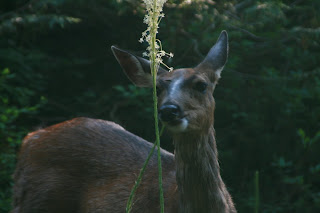
At Deer Lake, we noticed that the top of the Bear Grass blooms had been chewed off. A deer demonstrated who and how as we folded up our camp on day three.

The views of Mt. Olympus and then the peaks and vallies of the Seven Lakes Basin were tremendous. Jared was especially taken by the Hoh River Valley nearly a mile below us. Unfortunately, a stop to enjoy the scene was tempered by the cloud of bugs that attacked the loitorer. My usual style pausing or even sitting for an extended period of time to enjoy a particularly joyful view was suspended. With this form of expedited travel, we were arriving at campsites much earlier than planned and our arrivial at Deer Lake in the early afternoon was no surprise.

Mt. Olympus could be viewed from nearly the entire route on the High Divide Trail.

Later in the day, we took a swim in the chilly waters and I reveled in the feel of mountain water on my tortured flesh. Better yet, the loss in elevation to a mere 3,500 feet dropped the population of flies to less than nightmarish.

Deer Lake could be seen in the distance, but it was much farther than it looked.

Deer Lake provided an excellent swimming pool in the mid-elevations of the Olympic Mountains.

Friday morning we slept leisurely and departed camp around 8:30am and arrived at the Sol Duc Trailhead at around 11:00am.

Lake Number 8 is one of many lakes in the Seven Lakes Basin and perhaps named with a touch of irony.

Overall, I count the loop as 22 miles even though I have yet to find any reports or maps that are consistent with each other. As advice to other hikers I would say hike clockwise. The trail is in amazing condition and my hat and respect goes out to the generations of Olympic National Park trail crews and enginieers that maintain this incredibly difficult route. On Thursday, we found a crew from the Washington Trails Assocition completeing work in the hot sun that parks service crews had marked as needs. There are several miles between Bogacheil Peak and the junction of the Seven Lakes Basin that could fall off the ridge at a natural whim.

The Upper Bogachiel River Valley of Olympic National Park is one area were the trail is hanging on to the side of a ridge and could be removed at the whim of any natural event.

In our haste, we were never able to visit the Seven Lakes Basin or any of the lakes therin. Thereby giving us the crack in which to plan another trip to the area.

Parting Shot....
Beargrass reflects in Heart Lake along the High Divide Loop in Olympic National Park.

Monday, August 3, 2009

Sunset/Sunrise


Some people wait for weeks to find scenes like this. This was the result of camping one night on Rialto Beach in Olympic National Park. In recent weeks with the heat inland and the contrast between cold and hot right at the surfline, fog has been the dominant feature on the coast. On this evening, the fog was retreated off shore just enough to supply personality and contrast.


In the morning, the sun broke through but the fog provided allowed the rays of light to take on a more solid appearance.


Sunday, July 19, 2009

Summerland Allows Quick Access of Mt. Rainier Slopes

I have spent most of the summer roaming and recreating the forests and beaches of the Olympic Peninsula. Desperate to be back in the high mountains as the calendar turned mid-July, I heard about a trail at Mt. Rainier that was free of snow and open for exploration.

Heather displays color on the slopes of Mt. Rainier at Summerland.

Summerland is just around my two-hour drive definition of local playground equipment. The easiest way to access the area is drive 7 miles east of Packwood on Highway 12 and then urn north on Highway 123. When you arrive at the park road towards Sunrise Visitor Center take a left turn. You will drive by the Park Service entrance station where they will require an entry fee and then drive for three more miles to Fryingpan Creek.

A dense population of Glacier Lily resides along the Wonderland Trail in Mt. Rainier National Park. Summerland is one of many meadows that will feature amazing wildlower displays in the next few weeks.

The trail starts across the road from a small parking area and then proceeds on an incredibly gentle grade adjacent to Fryingpan Creek. The forest changes and those hikers that need instant gratification get occasional views of the Tahoma Ridge to the south. On my trip, the change into occasional meadow growth accented the scents of the seasons sojourn. In reality, the first 3/4 of the trail is incredibly easy. The last mile from the bridge over Fryingpan Creek to the plateau on Mt. Rainier's eastern flank is the only section that is even remotely challenging as the trail switchbacks up the ridge.

Little Tahoma towers over the Wonderland Trail and early season flowers on July 15th.

By doing the math, the total mileage from trailhead to the heavenly views as Summerland equals just over 4 miles. The overall ratio of effort to world class scenery made me feel downright guilty.

The Wonderland Trail continues towards Panhandle Gap from Summerland in Mt. Rainier National Park.

Summerland is famous as a location to watch the large mountain rodents known as Marmots. On our trip, we spent several hours among the talus slopes above the meadow, but not a marmot to be found. Of course part of the problem was that were there during nap time. On warm days, Marmots will be active in the morning and then again in the evening all the while snoozing through the heat of the day.

Clearly, those camping at Summerland have a clear advantage. If you would like to spend the night and dwaddle about the ridge, watching marmots and perhaps the sun set over Goat Island Ridge contact the National Park Service at Mt. Rainier. You can reserve one of the six secluded sites at Summerland. A couple of the sites are available on a first come, first serve basis.

A mountain stream flows through Summerland in Mt. Rainier National Park.

No matter how long you plan to stay, be sure to visit a place dominated by winter but named after the fair season.
 
eXTReMe Tracker